


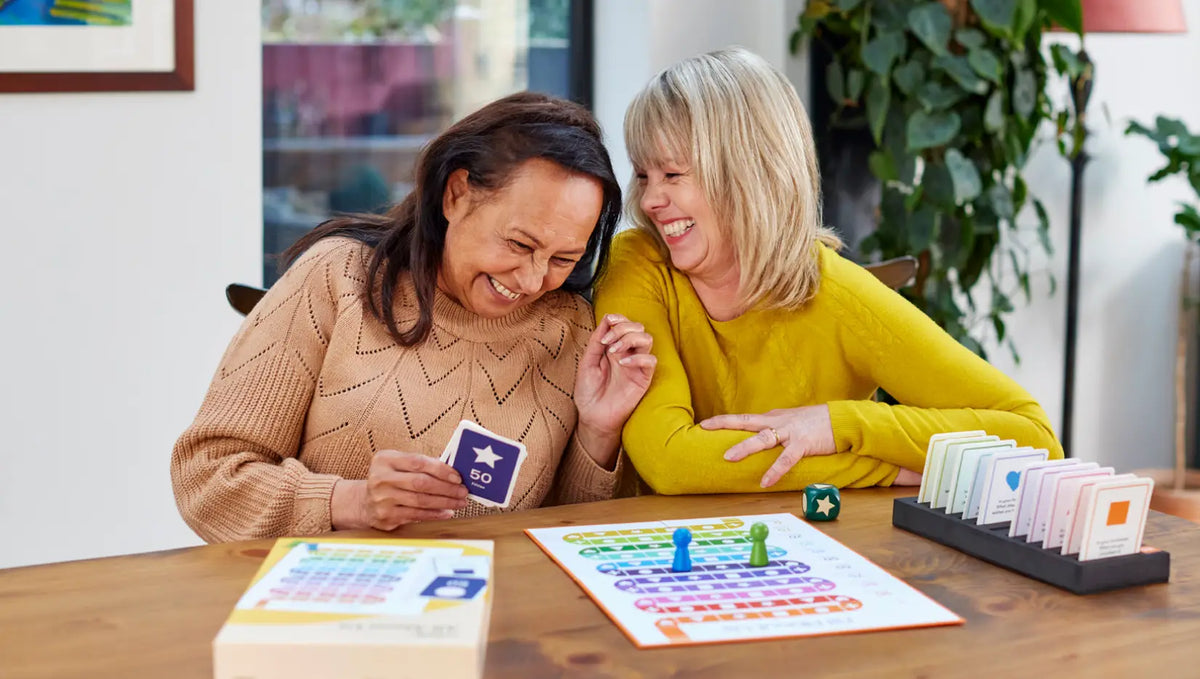
The Best Memory Games for Seniors and People With Dementia
The best memory games for people with dementia are the ones that bring out a story, a laugh, or spark a familiar moment without stressing the memory. Many memory games draw on the principles of cognitive stimulation therapy (CST), a structured set of themed activities for people with mild to moderate dementia.
According to the NHS, CST is well researched and has been shown to improve wellbeing and memory for people living with dementia, and the National Institute for Health and Care Excellence recognises it as an effective treatment. Games are not a cure for Dementia, but an afternoon spent playing one is genuinely worthwhile.
This guide walks through the best games to buy, matched to your loved one’s dementia stage. Every pick below is a Relish product, designed with dementia in mind.
Best memory games for people with dementia at a glance
|
Game |
Dementia Stage |
Price |
Why it works |
|---|---|---|---|
|
Early |
£29.99 |
Life-storytelling board game tested with 100+ people living with dementia |
|
|
Early to mid |
£14.99 |
Lively conversation, no right or wrong answers |
|
|
Early to mid |
£9.99 |
60 large-print puzzles at two difficulty levels, ideal for a quiet solo session |
|
|
Early to mid |
£29.99 |
Instrument sounds replace numbers; up to eight players, no reading required |
|
|
Mid |
£11.99 |
Bold picture cards, three game modes, no explanation needed |
|
|
Mid |
£24.99 |
Two well-known classics, adapted and simplified |
|
|
Mid to late |
£22.99 |
No rules or memory required, just calm, self-directed play |
|
|
All stages |
£17.99 |
From 13 to 100 pieces, scaled to any stage |
The best memory games to buy, by stage
The memory games below run from early to later stages, so feel free to scroll to whatever feels right for where you are. Or choose one or two that match your loved one's stage and interests today.
-
All About Us - Best for: Early Stage

All About Us is a board game built around life-storytelling. Players answer questions on different aspects of their whole lives, from childhood to the present day. It opens up the kind of deep conversation you don’t often get just sitting in front of the television. And because the questions draw on long-term memory, they feel natural rather than demanding.
The game was developed by Relish and the MinD project, and researchers across the UK and Europe, and tested with more than 100 people living with early-stage dementia. There are no complicated rules to learn. Players can adapt and enjoy the game easily, whether you are playing at a kitchen table or just sitting beside someone in their room.
One Trustpilot user has this to say: “All About Us allows for a variety of discussion; I use it for opening a dialogue with carers. Good unequivocal returns policy. Highly recommended”
Click here to buy All About Us at £29.99 (£24.99 with VAT relief).
-
Hobbies Conversation Game - Best for: Early to mid

The Hobbies and Conversation Game was inspired by cognitive stimulation therapy and developed together with people in the early to mid stages of dementia.
The game has large tiles and high-colour contrast, which helps anyone with dexterity or visual challenges. It works one-to-one or as a small group. To play, you have to roll the large wooden dice, pick up a handful of hobby tiles, and follow the prompt. There are no right or wrong answers, so nobody feels put on the spot.
Here’s what Barathaven Memory Care has to say, “We love the game bundle we ordered for our Alzheimer's/Dementia residents, and they do too. There were games at a few different levels so many could play and have fun.”
Click here to buy Hobbies Conversation Game at £14.99 (£12.49 with VAT relief).
-
Relish Wordsearch - Best for: Early to mid

The Relish Wordsearch is a book of 60 large-print word puzzles split across two challenge levels. Level 1 uses an 8x8 grid; Level 2 uses a 14x14 grid. Both have generous lettering, clean layouts, and no answers printed backwards.
It’s a great way to exercise your brain on your own, something to pick up over a morning cup of tea or during a quiet spell in the afternoon. The two levels mean it can grow with your loved one as their abilities change, and spotting a familiar word often sparks a conversation.
According to a Trustpilot user, “The level 1 wordsearch is just what I was looking for for my mum. Large print, not too many words to find, and the words are recognisable, unlike some word searches. The delivery was quick too. Thank you.”
Click here to buy Relish Wordsearch at £9.99.
-
Musical Bingo - Best for: Early to mid

Musical Bingo swaps numbers for sounds. A CD plays instrument clips, and players cover the matching picture on their bingo card when they recognise it. That little click of the counter going down is worth celebrating every time, not only when someone calls bingo.
Up to eight people can play, which makes it a lovely choice for family gatherings or a group afternoon in a care home. The CD can be paused and replayed as often as needed, so nobody ever feels rushed.
Click here to buy Musical Bingo at £29.99 (£24.99 with VAT relief)
-
Animal Snap - Best for: Mid Stages

Everyone knows Snap, and that is exactly the point. Animal Snap uses large, high-contrast picture cards, so the game can get started immediately with no rules required.
Three modes are included: Snap for a faster game, Pairs for a slower turn-based version, and Full House for collecting sets of four. Using half the deck makes for a shorter session. The images are bold and recognisable: elephant, lion, penguin, giraffe.
Here’s what a customer has to say: “My mother, who has no short-term memory, loves engaging with the various products we have bought for her. She has two jigsaws, a drawing book, cards (snap) and aqua paints. It is interesting to see how she improves the more she does. They are so thoughtfully designed.”
Click here to buy Animal Snap at £11.99 (£9.99 with VAT relief).
-
Snakes & Ladders and Ludo - Best for: Mid stages

Two games most people already know, brought together in one adapted set. The board is bright and uncluttered. Dice Cards replace traditional dice to make holding and rolling easier. The rules have been simplified, so there’s less time spent explaining and more time playing.
Up to four people can join in. Both games are competitive in the most cheerful way: climb the ladders, slide down the snakes, race your counter to the finish. Games rooted in shared memories carry a warmth that newer games can struggle to match.
One of our customers said, “Took the snakes and ladders/ludo game to a group of people with memory problems yesterday, and the people who played the game enjoyed the simplicity of the boards. One thing we all thought was that it would be nice to have a pack (say 24 cards or so) of the dice cards so as to keep the game flowing. Hope you will consider this.”
Click here to buy Snakes & Ladders and Ludo at £24.99 (£20.83 with VAT relief).
-
Dementia-Friendly Jigsaw Puzzles - Best for: All stages

Jigsaws grow and change with the stage, which makes them one of the most flexible options across the whole journey:
-
100-piece and 63-piece puzzles suit the early stages, offering a satisfying challenge without feeling overwhelming.
-
35-piece puzzles sit in the early- to mid-range, with larger pieces and calming scenes.
-
13-piece puzzles are designed for the mid to later stages, and can be completed right in the box, no table needed.
Every puzzle has adult-friendly, detail-rich scenes and large, sturdy pieces.
According to one of our customers, “My 89-year-old mum loves doing these jigsaws. It's great to see her engaged in an activity. Due to her many medical issues, she has to give up so many hobbies, but she manages to complete the jigsaws independently, and it gives her a real sense of achievement.”
Browse the full range by piece count in the jigsaw puzzles collection from £17.99 (from £14.99 with VAT relief).
-
Track Marble Maze - Best for: Mid to late

The Track Marble Maze needs no explaining and no rules. Tilt the board, guide the marble around the track, and feel the small satisfaction of each loop.
It is a self-directed, sensory activity with no memory involved, which makes it the right choice when a game with steps and turns feels too demanding. Calming rather than competitive, and easy to pick up and put down throughout the day.
See what a Trustpilot user has to say: “Finding ways to create positive engagement with elderly parents with dementia can be difficult. The maze, puzzles and water painting sheets we purchased have been sensational: simple yet absorbing and providing a real sense of achievement once completed. Highly recommended.”
Click here to buy the Track Marble Maze at £22.99 (£19.16 with VAT relief).
For more game ideas for seniors and people with dementia, browse the full selection in our dementia games collection.
How to choose the right memory game
-
Match the stage: A game that’s too challenging can cause frustration, and one that’s too easy can feel patronising. Our Find Your Stage quiz takes about two minutes and gives a clear recommendation.
-
Look for large prints and high contrast: Bold images and clear colours make play much easier for anyone with visual changes.
-
Use simple rules: Games with a well-known format get going faster, because the rules already feel familiar.
-
Avoid timers: For people with dementia, games are there purely for enjoyment. Adding a timer can take the joy out of that and add unwanted stress.
-
Think about group size: Some games work beautifully one to one, others shine in a group. Check the player count on the product page before buying.
-
Choose flexible formats: Games with multiple modes can scale up or down depending on the day.
Matching a game to the stage of dementia
Stage matters more than people expect. A game that works brilliantly one month may feel like too much a few months later, and that’s not a failure. It’s simply a sign to try something different.
-
Early stages: games with a gentle cognitive element tend to work best: the Hobbies Conversation Game, All About Us, and the Wordsearch.
-
Mid stage: simpler, well-known formats come into their own: Animal Snap, Snakes & Ladders and Ludo, and Musical Bingo.
-
Later stages: sensory activities tend to suit best: the Marble Maze, our jigsaw puzzles, and sound-based play.
For a detailed breakdown by stage, see our best dementia games guide.
Frequently asked questions
What is the best memory game to buy for someone with dementia?
The best memory game for someone with dementia depends on the stage. For the early stages, All About Us and the Hobbies Conversation Game both offer meaningful engagement without pressure. For the mid stage, Animal Snap, Snakes & Ladders, and Ludo are familiar and easy to get started with.
Which memory game suits early, mid, or late stage dementia?
The best memory games for early stage include the Hobbies Conversation Game, All About Us, and the Wordsearch. For mid stage: Animal Snap, Snakes & Ladders and Ludo, and Musical Bingo. For later stages: the Track Marble Maze or a 13-piece jigsaw. Our full stage guide goes into more detail on each.
What are good, simple games for someone with dementia?
Good, simple games for someone with dementia include Animal Snap, which needs no introduction, and the Track Marble Maze, which needs no rules at all. Musical Bingo is also very easy to pick up: listen for the sound, find the picture, cover it with a counter. For something conversation-based with no pressure, the Hobbies Conversation Game has no right or wrong answers.
Finding the right memory game
The best memory game is the one that matches your loved one's stage and interests today. If you are not sure where to begin, our Find Your Stage quiz takes just a few minutes and points you to the games and products that fit them best.
Prefer free activities? Our sister article, Free Memory Games and Activities for Dementia and Seniors, covers card bingo, memory trays, reminiscence activities, and more, all free to download and use at home or in a care setting.


