







More than 7 million Americans are living with Alzheimer's today, and that number’s expected to reach nearly 13 million by 2050. Music is one of the few things that stays within reach at every stage of that journey. Research on music and dementia has linked familiar songs to lower anxiety, calmer moods, and brighter moments of connection.
But only the right radio or music player designed for dementia makes that listening genuinely independent. Too many controls, a hard-to-read screen, or a volume dial that drops to silence can all turn a comforting habit into a source of frustration.
This guide covers five radios for people with dementia in 2026, from early-stage everyday listening to late-stage curated playlists, drawing on published research and verified product details across the category.
Relish is featured in this list and is its publisher.
The Best Radios for Dementia At a Glance
|
Radio |
Best for |
Stage |
Price |
|---|---|---|---|
|
Personalised independent listening |
All Stages |
$159.99 |
|
|
Tuning own stations, looks like a normal radio |
Early |
$34.99 |
|
|
Family member streams from a phone |
Early |
$79.99 |
|
|
One-button simplicity, pre-loaded music |
Mid-Late |
$199.99 |
|
|
Music only, lift-and-listen simplicity |
Late |
$79.95 |
What to Look for in a Radio for Dementia
Once the controls are set, the person living with dementia should be able to use it alone. That single idea sits behind every feature worth paying for.
Here is what matters most when choosing a radio for dementia:
-
Minimal controls: Fewer buttons mean less confusion. Look for radios where setup functions are hidden, leaving only what the listener needs each day.
-
Pre-set stations: Saving two or three named stations removes the need to tune each time.
-
Clear labeling: Handwritten name panels are more reliable for people living with dementia than numbered presets or digital screens.
-
Volume that never drops to silence: A dial that cannot reach zero means the radio is always audibly on when switched on, removing a common source of confusion.
-
Stage compatibility: The right radio for early dementia is different from the right radio at mid or late stage. Match the device to where your loved one is now.
-
AM, FM, or Bluetooth: AM/FM covers the whole country with no setup. Bluetooth adds the option for a family member to stream music from a phone, which suits some homes and not others.
The 5 Best Radios for Dementia, Seniors and the Elderly Compared
Every radio here has been chosen because it genuinely simplifies listening. Some are designed specifically to support people living with dementia through all the stages; others suit specific stages. Each entry covers who the product is for, what makes it stand out, and where its limits are.
Relish Radio - Best for: Personalized Independent Listening at Any Stage

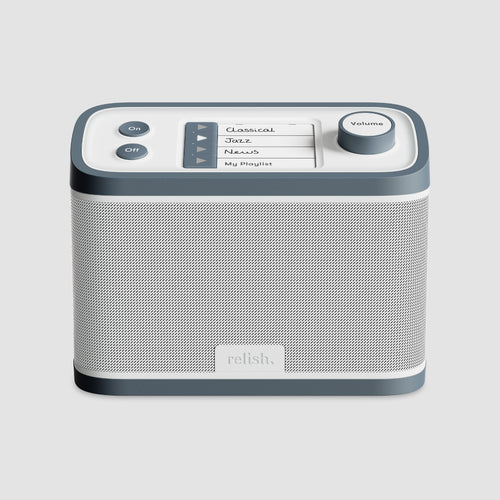
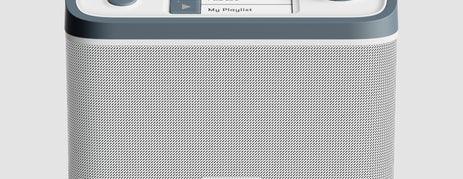
The Relish Radio was carefully designed for people living with dementia. If that is you, here is what you will find: three station buttons on top, each one with rewritable labels in your own words, and a fourth button for your own music. A volume dial that never goes silent, so you always know if it is on.
You or a caregiver set up the stations once, using a panel that sits out of sight at the back. After that, the radio is yours. It runs FM and digital stations, comes with a USB stick included, and carries a two-year warranty and 30-day free returns.
Buy our Relish Radio for $159.99.
Best features
-
Three pre-set buttons with handwritten labels, so each station name is whatever makes sense to the person listening.
-
Volume dial designed never to reach zero, so there is no confusion about whether the radio is on.
-
Fourth button plays a personal USB playlist of MP3 songs alongside the live radio options. The USB stick is included in the box.
Best for
Someone living with dementia at any stage who wants to listen independently. The labeled pre-sets support ownership early on; the simple controls hold up at mid stage; at late stage, a caregiver can set one station and leave it running.
Not ideal for
Someone who wants to browse stations freely, or families managing playlists on a Mac. USB playlist setup requires Windows for reliable results.
Panasonic RF-2400D - Best for: Early Stage Tuning Without Any Dementia-Specific Branding

The Panasonic RF-2400D is a compact AM/FM radio from a name most older adults already know. It has
no dementia-specific branding and looks like any other radio on a bedside table or kitchen counter. For someone in the early stages who is used to managing their own radio, that matters.
It tunes with a large slide-rule dial and a fluorescent pointer that is easy to see, even in low light. Runs on a wall outlet or four AA batteries.
Find the Panasonic RF-2400D for $34.99 on Amazon.
Best features
-
Large, easy-to-read tuning dial with a glowing pointer suits aging eyes and low-light rooms.
-
Familiar knob controls are simple for someone who has used a radio all their life.
-
Wall outlet or AA battery power means it works on a counter or moves room to room.
Best for
Someone in early-stage dementia who is comfortable with a couple of knobs and wants a radio that looks completely normal. A low-cost starting point before investing in a purpose-built model.
Not ideal for
Someone whose dementia has progressed beyond early stage. As dementia advances, the purpose of each knob becomes harder to identify. No personal music option and no saved presets.
Victrola Willow VRS-2800 - Best for: Early Stage With Family Streaming From a Phone
 The Victrola Willow is a retro wooden radio that does one thing the others on this list do not: it pairs with a phone over Bluetooth. A family member can stream a loved one's favorite playlist, an old radio show, or a worship service straight from their device, then leave the AM/FM dial for everyday listening.
The wood cabinet looks like a radio from the 1950s, so it reads as something familiar rather than a gadget.
Buy the Victrola Willow VRS-2800 for $79.99.
Best features
-
Bluetooth streaming lets a family member send any music from a phone or tablet, up to about 33 feet away.
-
Vintage wood design fits naturally into a living room and is instantly recognizable as a radio.
-
Built-in stereo speakers with bass and treble controls give a fuller sound than most compact radios at this price.
Best for
Early-stage dementia in a home where a family member wants to stream meaningful music from a phone. Works well alongside the listener's own AM/FM use.
Not ideal for
Someone past early stage, where the AM/FM/Bluetooth selector becomes a confusing extra control. This is a mainstream radio with no hidden setup panel and no fixed-volume safeguard. Pairing a phone over Bluetooth is a task for a family member, not the listener.
SMPL Music Player + Radio - Best for: Mid to Late Stage With One Button Left
 Sometimes the most helpful thing is radical simplicity. The SMPL Music Player + Radio combines an AM/FM radio and an MP3 player behind a single large On/Off button. A caregiver sets the volume and tunes up to ten stations once, using controls hidden on the base, then leaves the device ready to use.
It arrives pre-loaded with 75 American classics from the 20th century. A family member can add up to around 1,000 personal songs or audiobooks using the included 8GB USB stick.
Buy the SMPL Music Player + Radio for $199.99 from AlzStore.
Best features
-
One large On/Off button is all the listener needs; volume and tuning controls are hidden on the base.
-
Plays both AM/FM radio and MP3 music, with up to ten stations saved in memory.
-
Pre-loaded with 75 American classics; a caregiver can add up to about 1,000 personal songs or audiobooks.
Best for
Mid to late-stage dementia where a caregiver wants one fixed, fuss-free button and the reassurance of familiar music already loaded. Works across both radio and personal music without any visible setup.
Not ideal for
Someone who still wants to browse and choose stations freely. Adding personal music requires loading a USB stick on a computer first. At $199.99, it is one of the more expensive options here.
Little Birdhouse Music Box Player - Best for: Late Stage Where Radio Is No Longer Manageable

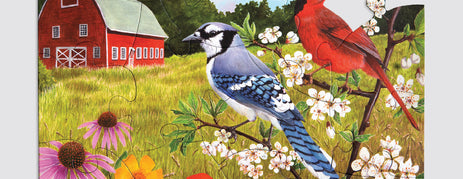
The Little Birdhouse Music Box Player is not a radio. It plays music loaded by a caregiver or family member. The interface is purposefully minimal: one front knob turns it on and controls volume, one side button skips to the next track.
At late stage, making sense of a display or pressing the right preset can become too abstract. Turning a single knob is not.
The hand-painted wooden box arrives pre-loaded with over an hour of American favorites by musician Tim Harper, so it plays the moment it is switched on. A USB port lets a family member add personal songs or audiobooks.
Buy the Little Birdhouse Music Box Player for $79.95 from AlzStore.
Best features
-
One knob and one button: turn it on, and the music plays. No screens, presets, or instructions needed.
-
Pre-loaded with over an hour of familiar American favorites, ready straight out of the box.
-
USB port lets a family member add personal songs or audiobooks from any computer.
Best for
Late-stage dementia where radio is no longer manageable and familiar music matters most. Simple enough that even someone with significant cognitive decline can operate it independently.
Not ideal for
Someone who still enjoys choosing their own stations or browsing. No radio function; it plays only what a caregiver has loaded or the songs it ships with. Music plays in a fixed order with no way to choose a specific track.
Is There a Dementia Radio Station?
There is no single national dementia radio station in the US, but you can build something close using a smart speaker, a streaming app, or a dedicated playlist like on the Relish Radio. Picking the decade that matches your loved one's younger years is usually the best starting point. Songs from someone's teens and twenties are the most emotionally familiar.
Most smart speakers handle this with a spoken request, such as asking for 1950s hits or big band music. A family member sets it up once, and after that the same station can be started with a few words.
Streaming needs an internet connection, so it is not a substitute for a physical radio for someone who needs to operate a device independently.
Which Radio Works Best as Dementia Progresses?
The right radio shifts as dementia progresses. For a radio that works across all stages of the process, the Relish Radio is your top pick. Other than that, here is what tends to work at each stage.
Best Radio for Early Stage Dementia
At the early stage, most people living with dementia still want to feel in control of their own listening. The Panasonic RF-2400D works well for someone who wants something normal-looking and mainstream.
So does the Relish Radio: the labeled pre-set buttons give a real sense of ownership, and the USB playlist keeps personally meaningful music within reach. The Victrola Willow suits homes where a family member wants to stream music from a phone.
Best Radio for Mid Stage Dementia
During mid stage, fewer choices make a real difference. The Relish Radio's labeled buttons hold up well for many people at this point. For the most stripped-back option, the SMPL Music Player + Radio removes every control but one: press to start, press to stop.
Best Radio for Late Stage Dementia
In late stage, radio listening can become very difficult. A device with one pre-set station may still bring real comfort. The Little Birdhouse Music Box Player often works better: familiar music, accessible with one physical gesture, chosen by someone who knows the person well.
If you are not sure which stage applies, Relish has a short Find Your Stage quiz to help you find the right starting point.
Frequently Asked Questions
What Is the Best Radio for People with Dementia?
The Relish Radio is the most complete option across all stages, with labeled pre-set stations, a USB music playlist, and a volume dial that never goes quiet. For early stage, the Panasonic RF-2400D is a more affordable starting point. For late stage, the Little Birdhouse Music Box Player works best.
Can Someone with Dementia Use a Bluetooth Radio?
Bluetooth lets a family member stream a loved one's favorite music straight from a phone, which can be a lovely way to share songs that matter. The pairing step is a task for the family member, not the listener, and the Victrola Willow handles it well at early stage.
What Type of Music Helps People With Dementia Most?
Music from a person's younger years tends to help most. Songs someone knew in their teens and twenties are the most emotionally vivid, and loading a few favorites onto a player like the Relish Radio or the SMPL Music Player keeps them within easy reach.
Finding the Right Radio
The product matters less than the principle: keep music accessible for as long as possible, with as little friction as possible. A radio that was perfect two years ago may need replacing. A device that looks too simple now may be exactly right in six months.
If you are not sure where to start, Relish's Find Your Stage quiz takes about two minutes and helps match the right product to where your loved one is today.


