

























Around six in ten people living with dementia will walk about at night at some point, according to research from Imperial College London's UK Dementia Research Institute. If you're one of the carers lying awake listening for footsteps, you're far from alone. That won't make the 3 am hours feel any easier, but you're not figuring this out from scratch.
Nighttime wandering is one of the most exhausting and frightening parts of living with or caring for someone with dementia. You don't have to manage it alone.
This guide covers why nighttime wandering happens, at what stage of dementia it typically begins, practical ways to reduce the risk, and how to put a safety plan in place.
Dementia night wandering at a glance
-
Nighttime wandering is common in dementia and can begin at any stage, though it's most frequent in the middle and later stages.
-
Common causes of nighttime wandering in dementia include a disrupted body clock, disorientation in the dark, unmet physical needs, and sundowning.
-
Simple changes to routine, lighting, and the sleep environment can significantly reduce the risk of nighttime dementia wandering.
-
The Herbert Protocol is a free UK police scheme that helps locate missing vulnerable people quickly.
-
Practical overnight help for carers is available through Dementia UK Admiral Nurses.
Why does nighttime dementia wandering happen?
Nighttime wandering almost always has a reason, even if that reason isn't immediately obvious.
Dementia disrupts the brain's internal clock (a system called the circadian rhythm), which governs when we feel alert and when we feel sleepy. When this rhythm is thrown off, a person may feel wide awake at 2 am, genuinely believing it's time to get up, go to work, or carry out a familiar task.
This confusion is often linked to sundowning, a pattern of late-afternoon and evening restlessness that sometimes spills into the night. Our guide to sundowning activities covers practical ways to manage these hours.
Disorientation plays a significant role, too. Waking in the dark in a room that no longer feels fully familiar can be frightening, and getting up might feel like the only sensible response.
Unmet physical needs, including hunger, thirst, pain, or restless leg syndrome, are also common triggers. These are often straightforward to address once they're identified.
What stage of dementia does nighttime wandering begin?
Nighttime wandering can begin at any stage of dementia, though it's most common in the middle to later stages. Restlessness and disrupted sleep may appear earlier, with walking about at night becoming more frequent as the condition progresses.
A person in the middle stages is more likely to feel disoriented after waking and less able to reason their way back to sleep. The gap between where they are and where they feel they should be can feel very real to them. Wandering can become less frequent in later stages as mobility decreases, though sleep disturbances typically continue.
Everyone's experience of dementia is different. Some people living with dementia never walk about at night at all. If you're reading this as someone living with dementia yourself, and you've noticed your sleep patterns changing, that's worth bringing up at your next GP appointment or with an Admiral Nurse.
The earlier those conversations happen, the more options are on the table. For carers noticing signs of nighttime restlessness, the same applies. Speak to your GP or an Admiral Nurse sooner rather than later.
How can I reduce nighttime wandering?
There's no single solution that works for everyone, but there are approaches that help many families. The strategies below are grouped around the most common causes: disrupted body clock, disorientation, unmet physical needs, and the home environment itself.

Try one or two changes at a time rather than overhauling everything at once. Small, consistent adjustments are easier for your loved one to adapt to and easier for you to stick with.
Build a consistent daily routine
A predictable daily routine gives the brain clearer signals about when to sleep and when to be awake.
-
Get outside for natural daylight each morning
-
Keep mealtimes consistent every day
-
Set a consistent bedtime and stick to it
-
Limit long afternoon naps; brief rest is fine, but extended naps shift the body clock
-
Allow at least two to three weeks before judging whether a new routine is making a difference
Our article on how clock changes affect people with dementia explains why seasonal shifts can unsettle sleep and what you can do.
Create a calming evening wind-down
The two hours before bed set the tone for the whole night. Try the following to help establish a calming evening routine:
-
Dim the lights gradually as the evening progresses
-
Switch off or lower stimulating television and noise before bed
-
Try calming music, a warm bath, or a gentle familiar activity to ease the transition to sleep
-
Avoid large meals, caffeine, or alcohol close to bedtime
-
Offer a light snack; it can prevent hunger, triggering an early waking
-
Keep the same sequence of small rituals each evening; the repetition becomes a signal that rest is coming
Our guide to calming sensory activities has ideas that work particularly well in the evening.
Help them stay oriented through the night
Waking in the dark, unsure whether it's 3 am or nearly morning, is often enough to prompt a get-up. The Alzheimer's Society recommends a bedside clock showing the time of day as one of the most practical aids for nighttime disorientation.
-
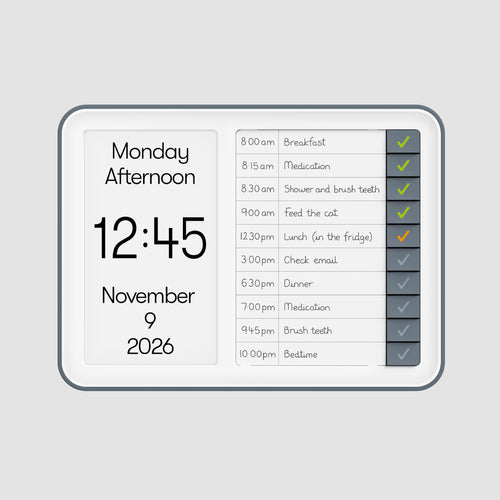
Place a dementia clock on the bedside table showing plain-language time periods, such as "morning" or "night", in large text
-
Keep curtains closed to block street lights and early morning light that can signal daytime
-
Leave a simple handwritten note or small whiteboard visible from the bed: "It is night. You are at home." This is a low-effort orientation cue the Alzheimer's Society endorses for confused waking.
-
Keep familiar objects, such as photos or personal items, visible from the bed to help anchor the person to where they are
If you're looking for a clock that meets those criteria, the Relish Day Connect displays the day, date, and a plain-English period indicator in large text, readable without needing to turn on a lamp.
Make the home safer at night
Some movement at night is likely regardless of routine. These changes reduce the risk of falls without restricting your loved one's freedom:
-
Fit motion-sensor nightlights in the hallway, bathroom, and bedroom
-
Clear the path from the bed to the bathroom of any obstacles
-
Place a door alarm or pressure-sensitive mat beside the bed for early movement alerts
-
Fit a simple bolt above eye level on external doors; it's often more effective than a standard lock and less likely to cause distress
-
Ask your GP or council to arrange a free home safety assessment through an occupational therapist
Manage physical needs before bed
These simple checks before bed remove the most common physical triggers for nighttime waking:
-
Offer a light snack and a small drink at bedtime
-
Limit fluids in the two hours before bed; make sure they've had enough to drink during the day to compensate
-
Raise persistent bladder problems with a GP - urinary tract infections can cause sudden confusion or delirium in people with dementia and are common in older adults, so prompt treatment matters
-
If your loved one seems unable to keep still at night, mention restless leg syndrome to their GP; it causes uncomfortable crawling or tingling in the legs and is often treatable
What should I do if my loved one wanders out?
Staying calm and acting quickly gives the best outcome, and the most important preparation happens before that moment arrives.
-
Check inside the house first. Look through all rooms and the garden before going outside. Familiar spots, like a favourite chair or the kitchen, are worth checking first.
-
Take your phone and a recent photo. Both are essential when searching outside and when calling for help.
-
Alert a trusted neighbour. Someone who knows your situation can cover ground and keep watch while you search.
-
Call 999 immediately. There is no waiting period to report a missing vulnerable person. Police treat it as an immediate priority.
-
Have the Herbert Protocol completed in advance. This free UK police scheme stores a pre-prepared profile of your loved one, including a photo, a description, and their likely routes, ready to share the moment they go missing. Register through your local police force or via the Herbert Protocol scheme on the Metropolitan Police website.
-
Tell their GP. A wandering episode is worth adding to your loved one's medical record.
How do I look after myself as a carer?
The worry of repeated nighttime wandering is exhausting, and that's true even on the nights when nothing happens. Lying awake listening, waking repeatedly to check, running on broken sleep: it takes a real toll.
Sharing the nighttime shift with a family member or trusted friend, even one or two nights a week, can make a meaningful difference. Reach out to Dementia UK's Admiral Nurses, specialist dementia nurses who offer free guidance for families at home, for free specialist advice on nighttime care and carer wellbeing.
You're also entitled to a carer's assessment under the Care Act 2014. Ask your GP or local authority to arrange one. It can unlock practical help, including overnight sitting services, respite care, and equipment for the home.
You can't care as well when you're running on empty. Asking for help is the most practical thing you can do, for both of you.
Frequently asked questions about dementia wandering at night
Is locking the bedroom door ever a safe option?
Locking a bedroom door is not recommended. It can cause significant distress and confusion and create a serious safety risk in an emergency. The aim is to manage nighttime movement, not prevent it entirely.
A door alarm that alerts you rather than blocks movement offers safety without restriction. Speak to an Admiral Nurse if you're unsure what the right approach is for your situation; they're trained to help with exactly these decisions.
When should I speak to a GP about nighttime wandering?
Speak to your GP if nighttime wandering starts suddenly or escalates quickly. A rapid change in behaviour can signal an underlying cause, such as a urinary tract infection, pain, or a medication side effect.
Raise it too if wandering is putting your loved one at serious risk or causing significant carer strain. A GP can review medication, rule out physical causes, and refer to appropriate services.
Can a dementia clock help with nighttime wandering?
A dementia clock can reduce the disorientation that often prompts nighttime wandering. Waking unsure whether it's the middle of the night or time to get up is enough to trigger movement. A clock that clearly shows the time period, such as "night" or "morning", can answer that question at a glance and encourage a return to sleep.
Browse our range of dementia clocks to find one that suits the bedroom.
What is the Herbert Protocol?
The Herbert Protocol is a voluntary UK police scheme that helps locate vulnerable adults who go missing. Carers complete a form in advance with a recent photo, a physical description, emergency contacts, and information about their loved one's typical routes and habits. This profile is shared immediately with officers the moment a missing report is made, so the search can begin straight away.
Police forces and emergency services across England and Wales participate. Contact your local force to register.
What overnight support is available for carers?
Several types of overnight care are available. Night sitting services, provided by some local authorities and charities including Crossroads Care and Carers Trust, involve a trained sitter staying with your loved one while you sleep. Respite care in a care home provides a longer break of several days or weeks.
Ask your GP or local authority to arrange a carer's assessment to find out what you're entitled to. Dementia UK's Admiral Nurses can also advise on accessing overnight services in your area.
Looking after your loved one through the night
Nighttime wandering is one of the harder parts of caring for someone at home, but there's a lot you can do to reduce the risk and feel better prepared.
Start with routine and the sleep environment, register with the Herbert Protocol, and reach out for help if broken sleep is taking its toll. A dementia clock on the bedside table can help your loved one feel oriented and settled through the night, without needing to wake you.
You're doing something truly difficult but incredibly important, so please do take all the help that's available to you.


